
The HIGG Index is a set of tools that allows brands, retailers and companies of any dimension – at all stages of their sustainability journey – to measure the performance of social and environmental sustainability. The HIGG Index was developed in 2012 by the Sustainable Apparel Coalition and is the central platform for standardized assessment of supply chain sustainability.
The HIGG Index is a platform that brings together several sustainability measurement tools divided into three major groups of activity:
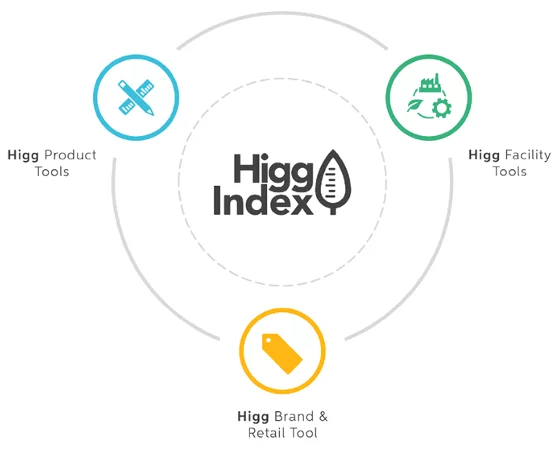
HIGG Product Tools helps HIGG users and customers to understand the sustainability impacts of products in the clothing, footwear and textiles sector.
For this purpose, three different modules/instruments of HIGG products are available:
HIGG Materials Sustainability Index
Allows designers to create custom materials, and in real-time understand their cradle-to-gate environmental impact.
The HIGG MSI measures:
- Water scarcity
- Eutrophication
- Chemicals
- Climate Change
- Resource Depletion and Fossils

HIGG Design & Development Module
Once you’ve selected materials, this allows designers to create composite products, taking into consideration material properties like durability, cutting efficiency, and blends, and create custom product libraries for designing efficient cradle-to-gate products.
The HIGG DDM measures:
- Water scarcity
- Eutrophication
- Chemicals
- Climate Change
- Resource Depletion and Fossils

HIGG Product Module
The most comprehensive of all of our suite of tools, the HIGG Product Module allows brands and manufacturers to compare the full life-cycle of products in any category, and see which processes most impact overall sustainability, at a fraction of the industry-typical time and cost. This module integrates with your business’s own internal systems to measure and generate analytics, and calculate environmental impact for numerous apparel, footwear, and textile products at industrial scale.
The HIGG PM measures:
- Impact of Materials & Design
- Manufacturing Impacts
- Logistics
- Retail
- Product Care
- End of Use Impacts
HIGG Brand & Retail Tools

This is a comprehensive tool that brands and retailers can use to measure the impact of individual products they sell in their stores, from cradle to grave, and their value chain. The HIGG Brand & Retail Module pulls in a whole range of data to give a better macro understanding of the supply chain, from cradle to grave manufacturing metrics, transportation of goods, and packaging, to measuring environmental cost of your office headquarters, for an exhaustive look at how your company ranks in sustainability.
The HIGG BRM measures:
- General (Management)
- Product Development
- Supply Chain
- Packaging
- Transportation
- Distribution Centers
- Retail Stores
- Product Use & EOU

HIGG Facility Tools
The HIGG Facility Tools, which includes the communication, environmental and social performance assessment modules applicable individually to the production facilities of the entire supply and value chain of clothing and footwear.
HIGG Facility Tools is divided into two major themes, the environmental and the social:

HIGG Facility Environmental Module
Assess environmental aspects of product manufacturing at facilities, from water use, to waste management, chemical and energy use, and more. This self-assessment replaces facility audits and empowers facilities to gain a clear understanding of their strengths, and hotspots to improve. Since its 3rd party verified, this assessment is widely shareable and can be used in place of traditional audits for an entire year, minimizing audit fatigue.
The HIGG FEM measures:
- Environmental Management System
- Energy Use
- Water Use
- Wastewater
- Emissions to Air
- Waste Management
- Chemicals

HIGG Facility Social & Labor Module
This module allows brands to holistically monitor the social impact of their manufacturing, and communicate with their facilities on items like employee treatment, health & safety, working hours, wages, and more.
The HIGG FSLM measures:
- Recruitment/Hiring
- Working Hours
- Wages & Benefits
- Employee Treatment
- Employee Involvement
- Health & Safety
- Termination
- Management Systems
Information Sources: